UD#128 The Making of a Harmony Part!
UD#128 The Making of a Harmony Part!
from Ukulele in the Dark with Guido Heistek
Harmony!
I learned harmony from listening to my grandparents sing together, and it also didn’t hurt that my Dad had many Everly Brothers 45RPM singles.
If you look at two-part harmony singing, you will notice that the vast majority of the notes are a third apart. In the case of the Everly Brothers, Don sang the melody, and Phil sang notes in harmony, mostly a third above. I often use the song “All I Have to Do Is Dream” to introduce this type of harmony to my students.
Here are the brothers singing their original version in the key of E:
Here is my ukulele arrangement in the key of C:
You may be wondering what a third is, so here are some examples:
The relationship between the notes C and E is called a third. Because, if C is 1, then E is 3.
C(1) D(2) E(3)
The relationship between D and F is also called a third. It’s a different kind of third, a minor third, but still a third.
D(1) E(2) F(3)
Question:
What note is a third above G?
Answer:
B is a third above G.
Question:
What note is a third below A?
Answer:
F is a third below A.
Hopefully that gives you an idea!
Let’s look at what the Everly Brothers did on “All I Have to Do Is Dream.” For simplicity, we’ll use the version in the key of C. Here are the first two bars in tablature:
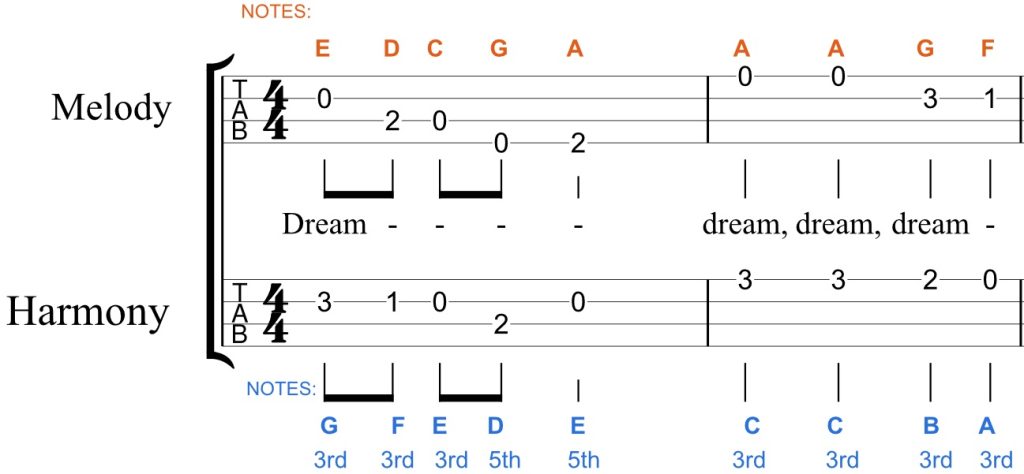
Don Everly’s melody part is above (Orange) and Phil Everly’s harmony part is written below (Blue). Notice, that for the two bars, Phil only sings two notes that aren’t a third above the melody. The last two notes of bar 1, Phil sings a fifth above the melody. In situations where a third won’t work, a fifth or a fourth will usually do the trick. More on that another time!
What’s next?
The full tab for today’s arrangement is below. Play it with your friends! We’ll explore singing the arrangement next lesson.
For those of you who are interested in doing something by ear, I’ve made a worksheet with the harmony part deleted so you can listen to the recording and transcribe the harmony part. The harmony part is in the right speaker or ear phone, which will help to isolate it if necessary. Have fun!
You might even try to create a harmony part of your own, and see how it compares to the final arrangement. It’s kind of a “choose your own adventure.” Here is the worksheet:
Here is the full tab with the melody and harmony written in so you can check your answers:
That’s all for this time! The next free lesson will come out in a month or so. We will look at singing harmony. I am happy to be doing this together!
All the best in your music making.
Guido